AI-Powered Productivity Blueprint
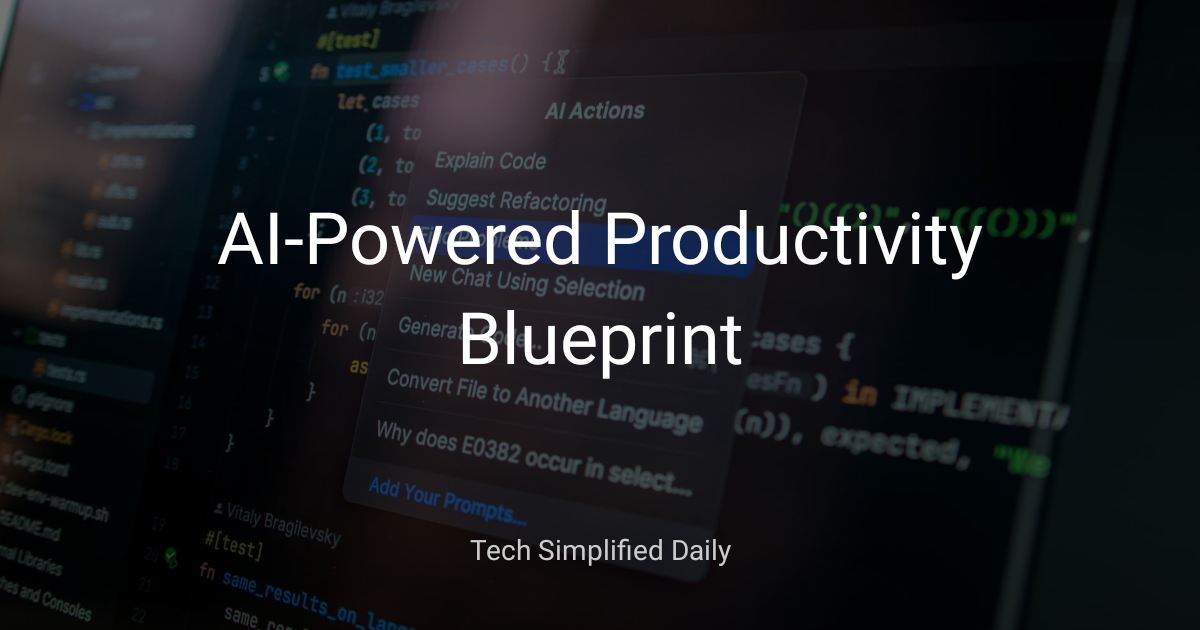
Welcome to Tech Simplified Daily, where we transform complex tech into actionable insights that genuinely boost your life. Today, we’re diving headfirst into a topic that’s not just trending, but fundamentally reshaping how we work, live, and create: Artificial Intelligence. The year is 2026, and AI isn't just a futuristic concept; it's an indispensable co-pilot for anyone serious about elevating their productivity.
Forget the science fiction narratives of sentient robots taking over; we're talking about practical, powerful tools that are ready to supercharge your daily routines right now. From automating mundane tasks to providing hyper-personalized insights, AI is no longer an optional upgrade – it's the essential blueprint for unprecedented efficiency. Join me as we unlock the secrets to leveraging AI to not just keep up, but to get ahead and truly simplify your incredibly complex digital life.
This isn't just about using a new app; it's about fundamentally rethinking your workflow and empowering yourself with intelligent assistance. Get ready to discover your AI-Powered Productivity Blueprint, a comprehensive guide designed to help you harness the full potential of these transformative technologies and reclaim your most precious resource: time.
The Foundation of AI Productivity: Understanding Your Digital Assistant Ecosystem
In 2026, the AI landscape is vast and incredibly diverse, offering specialized tools for virtually every facet of our professional and personal lives. To truly build an effective AI productivity blueprint, we first need to understand the categories of AI assistants available. Think of it as assembling a highly specialized team, each member excelling in their unique domain.
At the core, we have smart personal assistants, which have evolved far beyond simple voice commands. These agents now proactively manage schedules, anticipate needs, and even draft communications, learning from your habits to offer increasingly relevant support. They act as your central hub, orchestrating interactions between various other AI tools.
Next are the content generation and curation AI tools, indispensable for anyone involved in creation, communication, or research. These range from advanced writing assistants that can draft entire reports and marketing copy, to sophisticated summarizers that distill lengthy documents into key insights in seconds. Imagine having a ghostwriter, researcher, and editor all rolled into one, tirelessly working to refine your output.
Data analysis and predictive AI form another critical pillar, transforming raw information into actionable intelligence. These tools sift through massive datasets, identify trends, flag anomalies, and even forecast future outcomes with remarkable accuracy. For strategic decision-makers, this means moving from reactive responses to proactive, informed planning based on empirical, AI-driven insights.
Finally, we have automation and workflow optimization AI, the true workhorses that eliminate repetitive, time-consuming tasks. These intelligent automation platforms can handle everything from email sorting and expense reporting to software development and customer support. By offloading these routine chores, you free up invaluable mental bandwidth for higher-level, creative problem-solving.
Crafting Your Personalized AI Workflow: Strategies for Seamless Integration
Understanding the types of AI tools available is only the first step; the true magic lies in strategically integrating them into a personalized, seamless workflow. Your AI productivity blueprint isn't a one-size-fits-all solution; it's a bespoke system tailored to your unique needs and goals. This requires a deliberate approach to design and implementation.
Begin by conducting a thorough audit of your current daily and weekly routines. Map out your most frequent tasks, the applications you use, and the points where you feel friction or inefficiency. This audit will reveal opportunities where AI can step in and provide significant leverage, identifying specific tasks for automation or enhancement.
Once you’ve identified these opportunities, research and select AI tools that offer genuine solutions without introducing unnecessary complexity. Look for tools that integrate well with your existing software ecosystem, leveraging APIs and native connectors to create a cohesive environment. The goal is to reduce friction, not add another isolated application to your stack.
Next, implement a phased integration approach, introducing one or two AI tools at a time and thoroughly evaluating their impact. Don't try to overhaul your entire workflow overnight; gradual adoption allows you to learn, adapt, and refine your system. This iterative process is crucial for optimizing your AI blueprint and ensuring long-term success.
Continuously train and refine your AI tools. Many advanced AI systems improve with usage, learning from your preferences, feedback, and specific data inputs. Provide clear instructions, correct mistakes, and feed them relevant context to sharpen their performance over time. This ongoing interaction transforms your AI from a general tool into a truly personalized assistant.
Real-World AI Productivity in Action: Case Studies & Everyday Scenarios
Let's move beyond the theoretical and explore how an AI-powered productivity blueprint translates into tangible results across various real-world scenarios in 2026. These examples illustrate the diverse applications and profound impact AI can have on daily tasks and strategic objectives.
Scenario 1: The Content Creator's Accelerator
Imagine a marketing manager tasked with creating weekly blog posts, social media updates, and email newsletters. Their AI productivity blueprint might involve a generative AI writing assistant to draft initial outlines and even full paragraphs based on keywords and tone parameters. A separate AI tool then optimizes this content for SEO, suggesting keyword variations and structural improvements.
Before publishing, another AI application analyzes engagement metrics from previous campaigns to predict the best posting times and headline variations. This integrated approach drastically reduces drafting time, improves content quality, and maximizes reach, freeing the manager to focus on strategic campaign development and creative direction. The entire process, which once took days, can now be completed in hours.
Scenario 2: The Project Manager's Predictive Edge
A project manager overseeing multiple complex projects leverages an AI-powered project management platform. This system doesn't just track tasks; it analyzes historical project data, team member availability, and potential dependencies to proactively identify bottlenecks. It can predict potential delays before they occur and suggest optimal resource reallocation.
Furthermore, the AI automatically generates summary reports for stakeholders, highlighting progress, risks, and next steps, tailored to each recipient's specific information needs. This allows the project manager to move from reactive crisis management to proactive strategic guidance, ensuring projects stay on track and within budget with minimal manual intervention.
Scenario 3: The Researcher's Insight Engine
For an academic or corporate researcher, sifting through vast amounts of literature can be overwhelming. Their AI blueprint includes intelligent search agents that scour databases, journals, and news feeds, not just for keywords, but for contextual relevance. These agents then summarize key findings, highlight conflicting research, and even identify emerging trends in their field.
One AI tool might generate comprehensive literature reviews, while another cross-references data points to identify novel connections or gaps in existing knowledge. This accelerates the research process exponentially, allowing the researcher to dedicate more time to critical thinking, experimental design, and generating groundbreaking insights rather than exhaustive data collection.
Beyond the Basics: Advanced AI Productivity Techniques for Power Users
Once you’ve mastered the foundational AI tools and integrated them into your daily workflow, it’s time to explore advanced techniques that push the boundaries of AI-powered productivity. For power users, the goal isn't just efficiency, but unlocking truly transformative capabilities that redefine what's possible.
One powerful strategy is leveraging API integrations to create bespoke AI workflows that connect disparate applications and services. Instead of relying solely on out-of-the-box solutions, you can use AI platforms with open APIs to build custom automation sequences. This allows you to chain together multiple AI models and traditional software, creating highly specialized and hyper-efficient pipelines.
Consider the concept of "Agent Swarms" – deploying multiple specialized AI agents to tackle complex projects collaboratively. For instance, one AI agent might handle initial data gathering, feeding its findings to a second agent focused on analysis, which then passes processed information to a third agent responsible for generating a report. This distributed intelligence dramatically accelerates multi-faceted tasks.
Another advanced technique involves training your own custom AI models on your proprietary data. While more complex, this allows for unparalleled personalization and accuracy. Imagine an AI tailored to understand your company's unique jargon, specific customer queries, or niche market trends, delivering insights and content far superior to general-purpose models.
Finally, embrace proactive and predictive AI capabilities that anticipate your needs before you even articulate them. This could involve an AI that monitors your calendar, email, and project deadlines to automatically suggest optimal times for focused work, draft preliminary responses to common queries, or flag potential conflicts. The AI moves from reactive assistant to a strategic foresight partner.
Navigating the Pitfalls: Common Mistakes & Ethical Considerations in AI Productivity
While the promise of AI productivity is immense, it's crucial to approach its integration with an understanding of potential pitfalls and ethical responsibilities. Overlooking these aspects can lead to inefficiencies, compromised data, or even unintended negative consequences. My goal is to ensure your AI journey is smooth and responsible.
One of the most common mistakes is over-reliance without critical oversight, often termed "automation bias." It's tempting to blindly accept AI-generated output, whether it's a drafted email or a data analysis. Always maintain a "human in the loop" approach, reviewing and validating AI's work to ensure accuracy, context, and alignment with your intentions and values.
Neglecting data privacy and security is another significant pitfall. When feeding proprietary or sensitive information to AI tools, especially cloud-based ones, understand their data handling policies. Ensure compliance with regulations like GDPR or CCPA and choose providers with robust encryption and privacy safeguards. Your data is a valuable asset; treat it as such.
Another challenge stems from the "garbage in, garbage out" principle. AI models are only as good as the data they are trained on. Feeding incomplete, biased, or incorrect information will inevitably lead to flawed outputs and misinformed decisions. Invest time in curating high-quality data inputs to ensure your AI tools deliver reliable and valuable results.
Finally, we must consider the ethical implications, particularly regarding bias and accountability. AI models can inadvertently perpetuate and amplify biases present in their training data, leading to unfair or discriminatory outcomes. Power users must be vigilant in monitoring for bias and be prepared to intervene and correct the AI's behavior, ensuring equitable and just applications of technology.
Your AI-Powered Future: Embrace the Blueprint
We've journeyed through the intricate landscape of AI-powered productivity, from understanding its foundational components to crafting personalized workflows and navigating advanced techniques. You now have a comprehensive blueprint, not just for using AI, but for strategically integrating it to unlock unprecedented levels of efficiency and innovation in 2026 and beyond.
The core takeaway is clear: AI isn't just about doing more; it's about doing better, smarter, and with greater impact. By thoughtfully selecting and integrating the right tools, continuously refining your processes, and maintaining a critical, ethical perspective, you can transform your daily grind into a streamlined, highly productive experience. This blueprint empowers you to reclaim valuable time, reduce cognitive load, and focus your energy on what truly matters – creative problem-solving and strategic thinking.
So, what are you waiting for? The future of productivity isn't coming; it's already here, waiting for you to harness its power. Start small, experiment, and iteratively build your own AI-powered productivity blueprint. The sooner you begin, the sooner you'll experience the profound difference these intelligent assistants can make. Take the first step today, and begin simplifying your complex digital life with the intelligence of AI.